About Our Association

My photo
The Nebraska Floodplain and Stormwater Managers Association (NeFSMA) is an active organization of over 100 members representing over 50 organizations. NeFSMA pursues multiple purposes including: 1.)promote public awareness of floodplain and stormwater management; 2.) promote the professional status of floodplain and stormwater management and secure all benefits resulting there from; 3.) promote cooperation and information exchange between individuals and entities concerned with floodplain and stormwater management; 4.) keep individuals concerned with floodplain and stormwater management well informed through educational and professional seminars and to provide a method for dissemination of information, both general and technical; 5.) inform and educate concerned individuals of pending floodplain or stormwater legislation, funding and other related management matters. Please browse our website to learn more about NeFSMA at www.nefsma.net. If you are interested in joining, either contact one of the board members or complete the membership form.
Showing posts with label NPDES. Show all posts

Friday, May 27, 2011

Nebraska H2O Coordinates Stream Bioassessment Workshop

On May 18-19, the 10 member communities of Nebraska H2O coordinated a stream bioassessment workshop in Grand Island, Nebraska.  There were 15 attendees (MS4s, NRDs, UNL, and USGS) plus the two presenters from the Central Plains Center for BioAssessment at the University of Kansas.  Felsburg Holt & Ullevig arranged and facilitated the workshop.  The purpose of the workshop was to explore new methods to measure effectiveness of Storm Water Management Programs for MS4s. 

The CPCB has a summary and downloadable copies of the presentations available on their website - http://www.cpcb.ku.edu/workshops/html/2011_GrandIsland.htm and the first two videos on the NeFSMA YouTube Channel have been posted with small segments from the field tour portion of the workshop.


The group covered basic information about stream bioassessement concepts, methods, taxonomy, data collection, and reporting.  Half of the first day was held in the field.  The group visited a segment of the Wood River upstream of Grand Island which could be considered the reference condition where urban influences have not impacted the stream.  This is the location seen in the first video.

The group then moved to the sampling location which was near State Fair Park.  After some more introductions about field equipment and filling out the assessment forms (seen in the second video), anyone that wanted to could get into the Wood River and start trying their hand at sampling the stream. 


The workshop was successful and the feedback was great.  Nebraska H2O Communities hope to use stream bioassessment methods for algae, macro-invertebrates, and/or fish to more effectively monitor the impacts of stormwater pollution from their communities.  

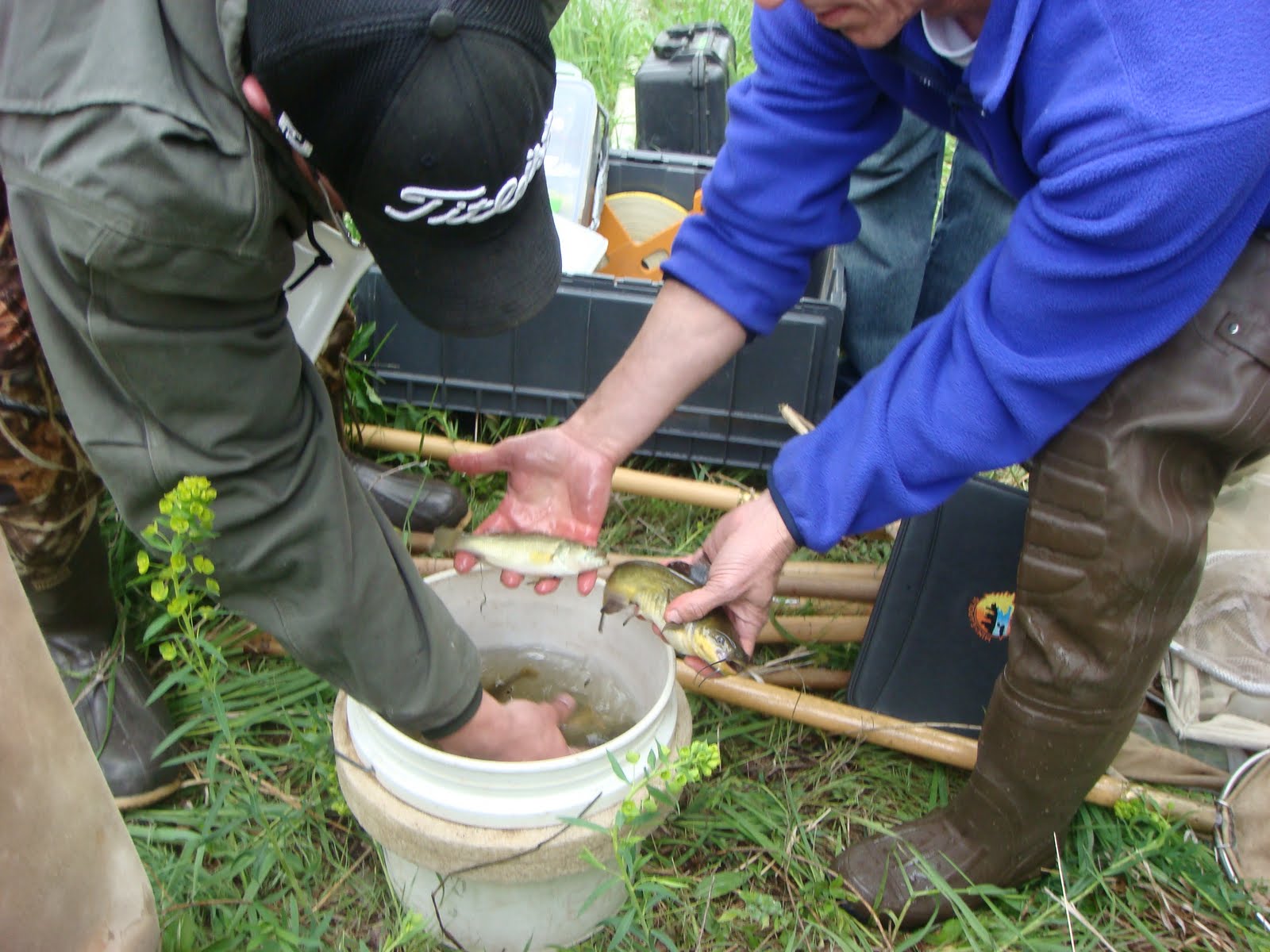
Don't think there are any fish or macroinvertebrates in our urban waters?  Check out these two photos which were taken AFTER the group had tromped around in the stream channel for about an hour. 


 Submitted by
Jesse Poore

Thursday, April 28, 2011

UWRI Releases Free Tool to Calculate Water Quality Capture Volume


If you are an MS4 or a Floodplain Administrator in Nebraska, you should consider using the WQ-COSM tool to get an accurate value of your local water quality rain event.  

If you are interested, we can consider running this simulation for a couple communities in Nebraska when we host the NeFSMA Annual Conference on June 23rd, 2011.  Send an email to jesse.poore@fhueng.com if you want us to consider running the tool for your community at the conference.

URBAN WATERSHEDS RESEARCH INSTITUTE

To all stormwater management professionals:

The Urban Watersheds Research Institute, with the help and guidance of the Urban Drainage and Flood Control District and the Civil Engineering Department of the University of Colorado Denver, developed new software for the sizing of the Water Quality Capture Volume (WQCV), an essential part of stormwater best management practices (BMPs) that control the volume and rates of runoff. 

This software calculates surface runoff using continuous simulation.  To do so, it uses continuous 15- and 60-minute rainfall data available from the National Climatologic Data Center.   Two runoff options are available, the Rational Method and the modified Horton's Equation, similar to that employed by the EPA SWMM 5.0 model.  Runoff is based on the hydrologic properties of the tributary catchment and will work anywhere in the country.  The WQCV is calculated using the runoff volumes generated and the user-input drain time for this volume, something the user should know for the BMP being designed.

The model provides the user with a comprehensive list of WQCVs to choose from along with the percent of all runoff volume captured, as well as the percent of the storm events captured in total for each capture volume.  In addition, the maximized WQCV (i.e., the point of diminishing returns) is also identified for the user to consider.  This information greatly simplifies the sizing and the design of BMPs.  Best of all, it is simple to use and BMP design is then based on continuous simulation results using rainfall data collected over long periods of time (i.e., most of the time exceeding 20 years) and not on synthetic design storms. 

A document describing what the software does, the software itself, and the user manual may be downloaded and used at no cost from the following three links: 


UWRI would appreciate hearing from you if you use it, how it performs and what enhancements or changes you would like to see implemented in the future.  E-mail Ben Urbonas your comments at info@urbanwatersheds.org.

Ben Urbonas, PE, D.WRE
President
Urban Watersheds Research Institute

Thursday, April 21, 2011

NeFSMA Stormwater Round Table = Successful on All Accounts

Congratulations to all 70 attendees of the Nebraska Statewide Stormwater Round Table discussion for making the event memorable and extremely worthwhile.  Over 90 people, including 22 sponsors, registered for the event and supported the objective of the meeting which was to advance the discussion about how Nebraska will implement effective Post-Construction Stormwater Quality Programs.

Our apprection goes out to the speakers for their time and knowlege shared: 
Pat Sauer - Iowa Stormwater Education Partnership
Ken MacKenzie - Urban Drainage Flood Control District
Kelly Feehan and Dave Shelton - University of Nebraska Extension
Selma Kessler - City of Omaha
Rock Krzycki - City of Lincoln
Annie Folck - City of Scottsbluff
Ron Poe - Nebraska Department of Roads

Facilitators for the event will compile the meeting summary and list of action items soon.  We will distribute that to as many people as are interested.  The discussion was upbeat and constructive.  Let's carry that energy forward to implement as many of the items that were discussed as possible.  Below are some photos from the event.

Pat Sauer stressed the critical mass for stormwater outreach that was created in Iowa around flooding and how Partnerships are the key to success.  One attendee asked, where can we get a Pat.  Great question.  Thank you Pat!

Ken MacKenzie shared how the UDFCD Volume 3 has drastically improved in 2010.  Local BMP research and consistent funding mechanisms are paving the way for more effective implementation of water quality BMPs in Colorado.  Thank you Ken!

Jesse Poore, Rock Kryzcki, and Rocky Keehn facilitated the break out session that addressed perceived Hurdles to Effective Post Construction Programs in Nebraska.  You can see by the wall, we covered a lot of ground!

Kelly Feehan, Steve Rhodie, and Dave Shelton facilitated the break out session that addressed Resources needed to support Effective Post Construction Programs in Nebraska.  They had a great dialogue that will help inform our next steps.  Everyone has a role to play.

Friday, March 18, 2011

9th Circuit Court Holds Municipal Permittees Liable For Stormwater Releases

You can view the original source Here.  For those following the ongoing struggle to regulate numeric water quality standards for TMDLs through MS4 Permits, consider this ruling as additional precident setting.

March 10, 2011: The 9th Circuit Court of Appeals upheld a decision today finding the Los Angeles County’s Flood Control District responsible for the billions of gallons of untreated stormwater runoff it allows to pollute Southern California’s rivers and, ultimately, its most popular beaches. The decision stems from a 2008 lawsuit filed by NRDC and Santa Monica Baykeeper. In a March 10 ruling in Natural Resources Defense Council (NRDC), et al. v. County of Los Angeles, et al., the U.S. Court of Appeals for the 9th Circuit ruled that the county's flood control district is responsible for excess stormwater discharges into two rivers containing pollutants at levels above permit limits. The ruling comes as EPA is stepping up its efforts to regulate stormwater.

“This ruling holds LA County responsible for their massive water pollution problem,” said Aaron Colangelo, senior attorney with NRDC. “For years, the County claimed that it could never be held accountable for its toxic discharges, even if the water were so polluted that it literally caught on fire. All of that changes with this ruling. The result will be fewer illnesses, fewer beach closings, a healthier environment, and a healthier regional economy.”

This ruling affirms that the County must do more to improve water quality and protect public health and the environment. As a remedy for the violations identified by the court, NRDC and Santa Monica Baykeeper will seek a court order requiring the County to reduce runoff pollution to levels that protect public health and the environment.

In its decision, the federal court agreed with NRDC and the Baykeeper that Los Angeles County, through its Flood Control District, has been illegally discharging polluted water into the Los Angeles and San Gabriel Rivers since 2003. Although the County’s monitoring in two additional rivers – the Santa Clara River and Malibu Creek – also showed violations of pollution limits, the court found that evidence did not pinpoint the County, as opposed to other dischargers, as the source of illegal levels in those waters. However, the Court left it open for NRDC and Baykeeper to revisit those claims. Specifically, the dischargers are responsible for permit exceedances of aluminum, copper, cyanide, fecal coliform bacteria and zinc that are discharged into rivers at monitoring stations owned by the municipal separate storm sewer systems (MS4s).

The court strongly rejected industry defenses that Congress did not intend the Clean Water Act (CWA) to apply as strictly to stormwater permits as to traditional National Pollutant Discharge Elimination System (NPDES) permits. The 9th Circuit also confirms that stormwater channeled by man in any conveyance system is a point source under the CWA and subject to the water act permitting system."

Thursday, March 10, 2011

LB 683 Amendment 738

The Natural Resources Committee of the Legislature was presented with Amendment 738 to LB 683 prior to today's session.

Previous Bill - Create the Storm Water Management Commission

Revised Bill - Create the Metropolitan Storm Water Management Commission

In doing so, the following proposed commission members were removed
*Representative appointed by Director of NDEQ
*Representative appointed by Director of NDNR

The following proposed commission members were added
*Representative of the Revenue Committee
*Representative of NRD Board Member in the Metropolian Class City

The final report date for the commission is now proposed as December 1, 2011

Senator Heath Mello described the situation causing the need for this bill as "an economic crisis" in Omaha and for Nebraska.  The focus fo the revised bill has been squarely placed on the rate structure of the $1.7 Billion dollar, 15-year sewer separation Long Term Control Plan costs.  As an Omaha World Herald article previously laid out, the current rate plan is going to put 5% of the total cost of the Plan on the backs of 29 "major industrial users" through flow charges and customer charges avereging $3 Million apiece over 15 years.  They are asking for any solutions that shift the cost more equitably.

Senators continually asked the Proponents of the Bill (7) what they were asking of the Legislature, if this was a funding issue for the City of Omaha, and if they were asking for money from the State.  Everyone knows, the State doesn't have open purse strings right now, so "what would be the outcome of such a study." Or as Senator Christensen put it, "what are you asking the Legislature to tell the City of Omaha to do?  They have to have leadership in this matter.  What are you asking us to provide?"  Senator Langemeier (Chairman) made it abundantly clear that there better be a good reason to commit his time to this Commission and there better be some definate outcomes.  Industries in attendance, including lobbiest Julia Plucker, agreed that approving the Commission would provide good assurance that everyone was working together to find the best solutions. 

It took two-hours for the discussion to come around to the fact that this study might include considering the stormwater user fee, stormwater tax, stormwater utility (whatever you want to call it) which some Senators remembered from previous years.  In case they didn't, the City of Omaha provided the last version that went to the Urban Affaris Committee in 2007.  One outcome of the study, could be a revisitation of why the State Legislature may or may not be inclined to enable legislation for municipalities to charge stormwater user fees.

There were no Opponents to the Bill.  Three individuals provided Neutral testimony.  These included the Car Lot contingent who could smell "the tired stormwater bill" from a mile away and wanted to remind the Committee that "this is a sewer separation bill, not a stormwater bill."  NeFSMA was represented to state simply that, "the implications of this study could have impacts beyond the City of Omaha."  As Marty Grate and Steve Oltmans had alluded during thier response to testimony questions, Omaha would be open to looking at the stormwater utility enabling legislation once again that would allow billing property a fee based on impervious surface area contributing to the storm drain system.  This would impact the many MS4s in Nebraska and I felt that point needed to be made known.  Finally, the Nebraska Cattleman Lobby testified that the increased cost of meat packing in Omaha would put their "Beef Epicenter of the World" mantra in difficult straights.  The Senators were ready for a break and asked no questions of the Neutral testifiers.

Just to make it clear, NeFSMA does not testify for or against legislation and we did not do so today.  Today, we were in the room and our presence and interest in the purpose and outcome of the proposed study was made known.  Legislative Aid - Trevor Fitzgerald - will be keeping NeFSMA aprised of new developments.  The Committee is getting ready to debate priority bills, so the future of this one is unclear.  As Senator Mello put it today, "there are many ways to get this Emergency Bill through the legislative process."  So with that, we'll keep you updated on the latest news for LP 683 AM 738 as it unfolds.

The AM 738 Text


Wednesday, February 23, 2011

LB683 Committee Hearing Date - 3/10/2011

The Natural Resources Committee of the Nebraska Legislature will hold a hearing on LB683 which would establish a Stormwater Management Commission.  The hearing is scheduled for March 10 in Room 1525.  It is last item on the agenda that starts at 1:30.  The link below will take you to the February 22 Legislative Journal which printed the notice on page 619.

http://nebraskalegislature.gov/FloorDocs/Current/PDF/Journal/r1day32.pdf

And here is a link to the site we are following to get updates.

http://www.nebraskalegislature.gov/bills/view_bill.php?DocumentID=12829

Friday, February 18, 2011

OWH Article

An article from the OWH detailing some of the challenges associated with funding the City of Omaha's CSO Program.

Will sewer fees push some out? - Omaha.com

NeFSMA does not support or oppose any current legislative issues.

Thursday, February 17, 2011

NeFSMA First Quarter 2011 Meeting Presentations

For your viewing and downloading pleasure, all of the powerpoint presentations from the 10 February NeFSMA meeting have been placed on the web for download until Wednesday, March 2, 2011. Get 'em while the're hot!  They can be found at the following links:

The file 'S1 - Stormwater Management & UNL.pdf' (3.4 MB) is available for download at :
http://dropbox.unl.edu/uploads/20110302/54c38f17c24037bf/S1%20-%20Stormwater%20Management%20%26%20UNL.pdf

The file 'S2 - NDEQ Planning and Permitting.pdf' (47 KB) is available for download at
http://dropbox.unl.edu/uploads/20110302/506c4e55ffabd959/S2%20-%20NDEQ%20Planning%20and%20Permitting.pdf

The file 'S3 - NDOR Inspection by EPA.pdf' (1.0 MB) is available for download at
http://dropbox.unl.edu/uploads/20110302/d9654e04c8643bc8/S3%20-%20NDOR%20Inspection%20by%20EPA.pdf

The file 'S4a - Lincoln Large Sites Construction Program.pdf' (1.2 MB) is available for download at
http://dropbox.unl.edu/uploads/20110302/8df4e80af752ee30/S4a%20-%20Lincoln%20Large%20Sites%20Construction%20Program.pdf

The file 'S4b - Lincoln Small Sites Construction Program.pdf' (6.3 MB) is available for download at
http://dropbox.unl.edu/uploads/20110302/1add363185dbfe2e/S4b%20-%20Lincoln%20Small%20Sites%20Construction%20Program.pdf

The file 'S5 - Omaha Construction Enforcement Program.pdf' (2.6 MB) is available for download at
http://dropbox.unl.edu/uploads/20110302/90f7b87783fe19a7/S5%20-%20Omaha%20Construction%20Enforcement%20Program.pdf

The file 'S6 - Inspection Findings Model Framework.pdf' (235 KB) is available for download at
http://dropbox.unl.edu/uploads/20110302/dbe23a219ae6ea63/S6%20-%20Inspection%20Findings%20Model%20Framework.pdf
Thanks to Bobbi Holm with UNL Extension in Douglas and Sarpy Counties for uploading these for us.  If you wish to receive the presentations after the expiration date, please let us know.

Thursday, January 20, 2011

University of Nebraska Water and Natural Resources Lectures

The UNL Water and Natural Resources Lectures for this Spring Semester have been announced.  If you are able, NeFSMA encourages you to put them on your calendar and make plans to attend.  NeFSMA is not a sponsor, but the information being provided is directly related to our mission. 

The UNL Extension Stormwater Management Team is co-sponsoring four speakers that we want to highlight to you.  Each event is FREE to the public.  NeFSMA has been asked for ideas of how to make use of these presenter's time while in Lincoln beyond their presentation.  If you have suggestions, please let us know by posting a comment below.

When: 3:30-4:30 pm

Where: Hardin Hall, UNL's East Campus (N. 33rd and Holdrege Sts.)

March 16 - Bruce Ferguson with the University of Georgia will present Porous Pavements in North America

March 30 - John Gulliver with the University of Minnesota will present Innovations in Stormwater Treatment

April 13 - Bill Hunt with North Carolina State University will present Research and Design of Green Stormwater Management Practices

April 27 - Tom Liptan with the City of Portland, Oregon will present Integrating Water and Vegetation to Transform Our Cities: Experiences from Portland, Oregon

Double click the brochure below to view more information about the Stormwater Series


For more information, visit: http://watercenter.unl.edu/Archives/SpringSeminars2011.asp

Thursday, December 30, 2010

Hearing to be Scheduled for Proposed Industrial Stormwater General Permit

NDEQ News

For more information, contact
DEQ's Public Information Office, (402) 471-4223 or (402) 471-4243
--------------------------------------------------------------------------------

Hearing to be Scheduled for Proposed Industrial Stormwater General Permit

Dec. 29, 2010 -- The Nebraska Department of Environmental Quality intends to schedule a public hearing regarding the proposed issuance of a new Industrial Stormwater General Permit. The public comment period ended on Dec. 17, 2010, and, based on comments and a request for a public hearing, NDEQ Director Mike Linder decided that a hearing will be scheduled to receive further comment on the proposed general permit.

The date, time and location of this hearing are pending, but will be posted on this web site in the near future.

To view the NDEQ News item which contains the draft Industrial Stormwater General permit, go to http://www.deq.state.ne.us/Press.nsf/pages/NEWS100110. There may be some additional revisions made to this draft prior to the public notice of the hearing. Any revisions will be posted on this web site and will be available at NDEQ's Lincoln office at the time that the hearing is placed on public notice (this announcement will be made at least 30 days prior to the hearing date.)

A final decision on whether to issue or modify the draft general permit will be made after all comments from the public hearing and comment period are reviewed and considered.

It should also be noted that until a final decision on the proposed general permit is made, the existing Industrial Stormwater General permit will continue to be in effect. To view the existing Industrial Stormwater General Permit, go to http://www.deq.state.ne.us/Publica.nsf/pages/WAT011 .