
About Our Association
- Nebraska Floodplain and Stormwater Managers Association
- The Nebraska Floodplain and Stormwater Managers Association (NeFSMA) is an active organization of over 100 members representing over 50 organizations. NeFSMA pursues multiple purposes including: 1.)promote public awareness of floodplain and stormwater management; 2.) promote the professional status of floodplain and stormwater management and secure all benefits resulting there from; 3.) promote cooperation and information exchange between individuals and entities concerned with floodplain and stormwater management; 4.) keep individuals concerned with floodplain and stormwater management well informed through educational and professional seminars and to provide a method for dissemination of information, both general and technical; 5.) inform and educate concerned individuals of pending floodplain or stormwater legislation, funding and other related management matters. Please browse our website to learn more about NeFSMA at www.nefsma.net. If you are interested in joining, either contact one of the board members or complete the membership form.
Showing posts with label Education. Show all posts
Showing posts with label Education. Show all posts
Friday, July 29, 2011
Educators Invited to "Discover a Watershed: The Missouri"
Click on the image below to open the registration form for a unique event sponsored by Nebraska Forrest Service and Project WET. This is for traditional educators and those natural resource professionals (MS4 Coordinators???) that engage youth about water resources. Ponca State Park is also one of Nebraska's gems. If you can't go, please make sure to forward this information to any educational contact you may have locally.


Thursday, July 28, 2011
Education Committee Soliciting Topics for 2012 Workshops
To all the NeFSMA members and those interested in what educational workshops NeFSMA provides, the Education Committee is asking for your feedback on topics/speakers that we should target for 2012. Your Board has worked hard to provide workshops that are engaging and relevant to our profession, but NeFSMA is a member-driven organization. Please submit your floodplain and stormwater ideas about what we should provide next year.
Seriously, this is your chance. Send an email to nefsma@hotmail.com and we will add it to the list of possible topics and speakers.
Seriously, this is your chance. Send an email to nefsma@hotmail.com and we will add it to the list of possible topics and speakers.
Monday, July 18, 2011
Nebraska H2O Updates Website, Social Interaction
The Nebraska Stormwater Cooperative - Nebraska H2O - has recently launched a completely reskinned version of their website. The link www.nebraskah2o.org will take you to a much improved site that incorporates new social media assets for public education through their blog and individual community news feeds. There is a lot of great stormwater protection work just getting started in these communities which will be shared through the website.
The website operates as a group information sharing platform to benefit as many residents, students, contractors, developers, city officials, and resource agencies in the State as possible. Congratulations to Nebraska H2O on the update! We look forward to watching your dynamic new website grow. A link on our blog and website will help people find you too.

The website operates as a group information sharing platform to benefit as many residents, students, contractors, developers, city officials, and resource agencies in the State as possible. Congratulations to Nebraska H2O on the update! We look forward to watching your dynamic new website grow. A link on our blog and website will help people find you too.

Friday, May 27, 2011
Nebraska H2O Coordinates Stream Bioassessment Workshop
On May 18-19, the 10 member communities of Nebraska H2O coordinated a stream bioassessment workshop in Grand Island, Nebraska. There were 15 attendees (MS4s, NRDs, UNL, and USGS) plus the two presenters from the Central Plains Center for BioAssessment at the University of Kansas. Felsburg Holt & Ullevig arranged and facilitated the workshop. The purpose of the workshop was to explore new methods to measure effectiveness of Storm Water Management Programs for MS4s.
The CPCB has a summary and downloadable copies of the presentations available on their website - http://www.cpcb.ku.edu/workshops/html/2011_GrandIsland.htm and the first two videos on the NeFSMA YouTube Channel have been posted with small segments from the field tour portion of the workshop.
The group covered basic information about stream bioassessement concepts, methods, taxonomy, data collection, and reporting. Half of the first day was held in the field. The group visited a segment of the Wood River upstream of Grand Island which could be considered the reference condition where urban influences have not impacted the stream. This is the location seen in the first video.
The group then moved to the sampling location which was near State Fair Park. After some more introductions about field equipment and filling out the assessment forms (seen in the second video), anyone that wanted to could get into the Wood River and start trying their hand at sampling the stream.


The CPCB has a summary and downloadable copies of the presentations available on their website - http://www.cpcb.ku.edu/workshops/html/2011_GrandIsland.htm and the first two videos on the NeFSMA YouTube Channel have been posted with small segments from the field tour portion of the workshop.
The group covered basic information about stream bioassessement concepts, methods, taxonomy, data collection, and reporting. Half of the first day was held in the field. The group visited a segment of the Wood River upstream of Grand Island which could be considered the reference condition where urban influences have not impacted the stream. This is the location seen in the first video.
The group then moved to the sampling location which was near State Fair Park. After some more introductions about field equipment and filling out the assessment forms (seen in the second video), anyone that wanted to could get into the Wood River and start trying their hand at sampling the stream.

The workshop was successful and the feedback was great. Nebraska H2O Communities hope to use stream bioassessment methods for algae, macro-invertebrates, and/or fish to more effectively monitor the impacts of stormwater pollution from their communities.
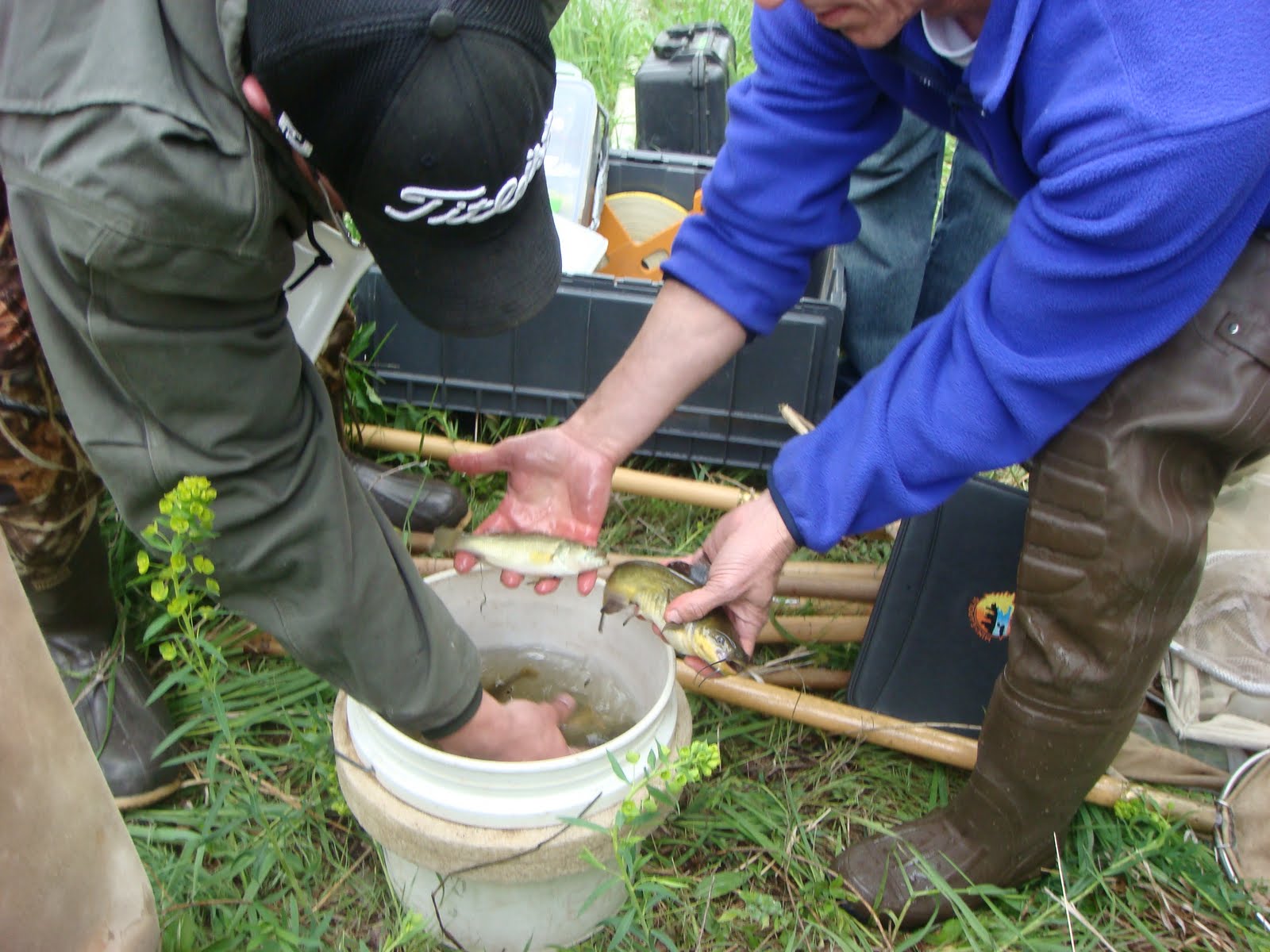
Don't think there are any fish or macroinvertebrates in our urban waters? Check out these two photos which were taken AFTER the group had tromped around in the stream channel for about an hour.

Submitted by
Jesse Poore
Thursday, April 21, 2011
NeFSMA Stormwater Round Table = Successful on All Accounts
Congratulations to all 70 attendees of the Nebraska Statewide Stormwater Round Table discussion for making the event memorable and extremely worthwhile. Over 90 people, including 22 sponsors, registered for the event and supported the objective of the meeting which was to advance the discussion about how Nebraska will implement effective Post-Construction Stormwater Quality Programs.
Our apprection goes out to the speakers for their time and knowlege shared:
Pat Sauer - Iowa Stormwater Education Partnership
Ken MacKenzie - Urban Drainage Flood Control District
Kelly Feehan and Dave Shelton - University of Nebraska Extension
Selma Kessler - City of Omaha
Rock Krzycki - City of Lincoln
Annie Folck - City of Scottsbluff
Ron Poe - Nebraska Department of Roads
Facilitators for the event will compile the meeting summary and list of action items soon. We will distribute that to as many people as are interested. The discussion was upbeat and constructive. Let's carry that energy forward to implement as many of the items that were discussed as possible. Below are some photos from the event.


Our apprection goes out to the speakers for their time and knowlege shared:
Pat Sauer - Iowa Stormwater Education Partnership
Ken MacKenzie - Urban Drainage Flood Control District
Kelly Feehan and Dave Shelton - University of Nebraska Extension
Selma Kessler - City of Omaha
Rock Krzycki - City of Lincoln
Annie Folck - City of Scottsbluff
Ron Poe - Nebraska Department of Roads
Facilitators for the event will compile the meeting summary and list of action items soon. We will distribute that to as many people as are interested. The discussion was upbeat and constructive. Let's carry that energy forward to implement as many of the items that were discussed as possible. Below are some photos from the event.

Pat Sauer stressed the critical mass for stormwater outreach that was created in Iowa around flooding and how Partnerships are the key to success. One attendee asked, where can we get a Pat. Great question. Thank you Pat!

Ken MacKenzie shared how the UDFCD Volume 3 has drastically improved in 2010. Local BMP research and consistent funding mechanisms are paving the way for more effective implementation of water quality BMPs in Colorado. Thank you Ken!

Jesse Poore, Rock Kryzcki, and Rocky Keehn facilitated the break out session that addressed perceived Hurdles to Effective Post Construction Programs in Nebraska. You can see by the wall, we covered a lot of ground!

Kelly Feehan, Steve Rhodie, and Dave Shelton facilitated the break out session that addressed Resources needed to support Effective Post Construction Programs in Nebraska. They had a great dialogue that will help inform our next steps. Everyone has a role to play.
Thursday, March 31, 2011
John Gulliver talks at UNL about the Minnesota Sand Filter and Unit Treatment Processes
A very good reference for describing Fundamental Unit Processes is a National Cooperative Highway Research Program Report published by the Transportation Research Board of the National Academies. In the 2006 NCHRP Report 565: Evaluation of Best Management Practices for Highway Runoff Control, Fundamental Process Categories characterize Unit Processes as "processes that influence a respective system's pollutant-removal mechanisms and efficiency". A single BMP may use multiple Unit Processes that "treat" stormwater runoff such as:
Hydrologic Operations:
-Flow and volume attenuation
-Volume reduction
Physical Treatment Operations:
-Particle size alteration
-Physical sorption
-Size separation and exclusion
-Density, gravity, inertial separation
-Aeration and volatilization
-Physical agent disinfection
Biological Processes:
-Microbiotically mediated transforamtion (oxidation, reduction or facultative processes)
-Uptake and storage
Chemical Processes:
-Chemical sorption processes
-Coagulation/flocculation
-Ion exchange
-Chemical disinfection
John Gulliver delivered the Water Resources Seminar topic on Wednesday March 30th, 2011. The topic was "Innovations in Stormwater Treatment". It was nice to see a larger crowd attend this time (estimated 100) to hear about the research being done by the University of Minnesota. At the St. Anthony Falls Laboratory, his research team is looking for ways to use a sand filter (physical treatment operation) that is amended to promote treatment of the dissolved portion of pollutants in urban stormwater flows.
Research available from Dr. Robert Pitt and others shows that up to 45% of the Phosphorous load in urban stormwater runoff is dissolved, meaning it won't settle or filter out. Many of the current BMPs that are designed for the landscape rely heavily on hydrologic and physical treatment operations and would not generally address the dissolved portion, leaving portions of the stormwater discharges untreated. This does not meet the regulatory requirements in the Clean Water Act. Even worse, in recent studies, some of the amended soils and compost layers installed into the Physical Treatment Operations and Biological Processes (constructed wetlands, bioswales, rain gardens) are actually shown to be releasing Phosphorous into the groundwater or underdrains.
_______________________________________________________________
"If a man has good corn or wood, or boards, or pigs, to sell, or can make better chairs or knives, crucibles or church organs, than anybody else, you will find a broad hard-beaten road to his house, though it be in the woods." —Ralph Waldo Emerson
_______________________________________________________________
To provide solutions to these two documented problems, the University of Minnesota team has developed great research supporting the use of an Enhanced Sand Filter to precipitate and/or adsorb the dissolved Phosphorous within the BMP. There are two sand filter types, the Austin and the Delaware, that have been in use for some time now. Precipitation of dissolved pollutants in a sand filter is generally undesirable as it would cause clogging. The "Minnesota Sand Filter" suggests enhancements to that sand filter BMP by adding an adsorption media such as iron filings, calcareous sand, aluminum oxide, steel wool, and steel industry by-products into the sand mixture.
Enhanced Sand Filter example is discussed here for a project in Maplewood, MN
Wet Pond Retrofit example is discussed here for a project in Prior Lake, MN
Other possible applications were presented as well and are being researched. During the social hour after the presentation, many innovative ideas of how to incorporate the Minnesota Sand Filter into other BMPs were discussed.
Many audience questions were proposed and discussed, such as:
-How communities would amortize the cost of replacement,
-If public or private installations were most common,
-What is the optimal amended media percentage (5% iron filings),
-Would there be interference from other pollutants,
-Would pretreatment be necessary, and
-Would biological growth in the media be a concern.
Are you interested in these questions? Does anyone in Nebraska want to be the first to experiment with the Minnesota Sand Filter? Leave a comment below about a project that you might consider this application for.
Follow the research team's work http://stormwater.safl.umn.edu/, but I'm sure we will hear much more about the Minnesota Sand Filter in the near term as Nebraska continues evaluating BMPs. Thanks again to the University of Nebraska Stormwater Team for lining up another great speaker. Next up is Bill Hunt, North Carolina State University-Extention April 13th at 3:30 inside Hardin Hall first floor auditorium on UNL East Campus.
Hydrologic Operations:
-Flow and volume attenuation
-Volume reduction
Physical Treatment Operations:
-Particle size alteration
-Physical sorption
-Size separation and exclusion
-Density, gravity, inertial separation
-Aeration and volatilization
-Physical agent disinfection
Biological Processes:
-Microbiotically mediated transforamtion (oxidation, reduction or facultative processes)
-Uptake and storage
Chemical Processes:
-Chemical sorption processes
-Coagulation/flocculation
-Ion exchange
-Chemical disinfection
John Gulliver delivered the Water Resources Seminar topic on Wednesday March 30th, 2011. The topic was "Innovations in Stormwater Treatment". It was nice to see a larger crowd attend this time (estimated 100) to hear about the research being done by the University of Minnesota. At the St. Anthony Falls Laboratory, his research team is looking for ways to use a sand filter (physical treatment operation) that is amended to promote treatment of the dissolved portion of pollutants in urban stormwater flows.
Research available from Dr. Robert Pitt and others shows that up to 45% of the Phosphorous load in urban stormwater runoff is dissolved, meaning it won't settle or filter out. Many of the current BMPs that are designed for the landscape rely heavily on hydrologic and physical treatment operations and would not generally address the dissolved portion, leaving portions of the stormwater discharges untreated. This does not meet the regulatory requirements in the Clean Water Act. Even worse, in recent studies, some of the amended soils and compost layers installed into the Physical Treatment Operations and Biological Processes (constructed wetlands, bioswales, rain gardens) are actually shown to be releasing Phosphorous into the groundwater or underdrains.
_______________________________________________________________
"If a man has good corn or wood, or boards, or pigs, to sell, or can make better chairs or knives, crucibles or church organs, than anybody else, you will find a broad hard-beaten road to his house, though it be in the woods." —Ralph Waldo Emerson
_______________________________________________________________
To provide solutions to these two documented problems, the University of Minnesota team has developed great research supporting the use of an Enhanced Sand Filter to precipitate and/or adsorb the dissolved Phosphorous within the BMP. There are two sand filter types, the Austin and the Delaware, that have been in use for some time now. Precipitation of dissolved pollutants in a sand filter is generally undesirable as it would cause clogging. The "Minnesota Sand Filter" suggests enhancements to that sand filter BMP by adding an adsorption media such as iron filings, calcareous sand, aluminum oxide, steel wool, and steel industry by-products into the sand mixture.
Enhanced Sand Filter example is discussed here for a project in Maplewood, MN
 |
| Sand filter enhanced with iron filings to remove dissolved phosphorous from stormwater (Maplewood, MN). (Courtesy A. Erickson) via link above |
Other possible applications were presented as well and are being researched. During the social hour after the presentation, many innovative ideas of how to incorporate the Minnesota Sand Filter into other BMPs were discussed.
Many audience questions were proposed and discussed, such as:
-How communities would amortize the cost of replacement,
-If public or private installations were most common,
-What is the optimal amended media percentage (5% iron filings),
-Would there be interference from other pollutants,
-Would pretreatment be necessary, and
-Would biological growth in the media be a concern.
Are you interested in these questions? Does anyone in Nebraska want to be the first to experiment with the Minnesota Sand Filter? Leave a comment below about a project that you might consider this application for.
Follow the research team's work http://stormwater.safl.umn.edu/, but I'm sure we will hear much more about the Minnesota Sand Filter in the near term as Nebraska continues evaluating BMPs. Thanks again to the University of Nebraska Stormwater Team for lining up another great speaker. Next up is Bill Hunt, North Carolina State University-Extention April 13th at 3:30 inside Hardin Hall first floor auditorium on UNL East Campus.
Thursday, March 17, 2011
Bruce Ferguson talks at UNL about Pervious Pavements in North America
On March 16, Bruce Ferguson with University of Georgia presented his observations about the evolution of porous pavements in North America to about 40-50 audience members at the UNL Water Center in Hardin Hall. Bruce encouraged the audience that many of the questions that have circled porous pavements in the past are now being resolved and answered through good research. He cited the great on-going work within the industry to define standards of practice that will help ensure the appropriate outcome once construction is completed. Standards such as ASTM C 1688 for material density, ASTM C 1701 for infiltration, ASTM C 936, 902, and 1272 for block pavers will all go a long way to help ensure the stormwater BMP is effective for the longest amount of time. Of course, a rigorous maintenance schedule is required to keep porous pavement working as designed. Bruce also highlighted some practical aspects of pervious pavements over standard pavements like developer cost savings and increased land use development densities.
During one segment of his presentation, he made the claim that using the correct installation techniques will create an underground environment where "oil ceases to exist". I had to write the quote down to ask him to clarify during the question and answer period. The bold claim honestly sounded a bit "Billy Mays-ish". But, one of the looming concerns that always comes up in discussion about pervious pavement is the possible risk of contaminating groundwater when oils seep through the surface of parking lots. Bruce referenced a 1990 Coventry Polytechnic (UK) study that could bring light to the subject of what soil micro-organisms do to oil in the soil column. This is the hyperlink I found which you can read at your leisure. What do you think? Can we "buy the claim" that, if pervious pavements are constructed and maintained correctly the question of oil leaching to groundwater can be put to rest? Leave your thoughts in the comments below.
If you missed this lecture, NeFSMA encourages you to take advantage of the next free events scheduled Wednesdays from 3:30-4:30. Highlighted speakers include Dr. John Gulliver speaking on Innovations in Stormwater Treatment on March 30, Bill Hunt speaking on Research and Design of Green Stormwater Management Practices on April 13, and Tom Liptan speaking on Integrating Water and Vegetation to Transform Our Cities: Experiences from Portland, OR. Put them on your calendars now if you haven't already. We'll see you there.
During one segment of his presentation, he made the claim that using the correct installation techniques will create an underground environment where "oil ceases to exist". I had to write the quote down to ask him to clarify during the question and answer period. The bold claim honestly sounded a bit "Billy Mays-ish". But, one of the looming concerns that always comes up in discussion about pervious pavement is the possible risk of contaminating groundwater when oils seep through the surface of parking lots. Bruce referenced a 1990 Coventry Polytechnic (UK) study that could bring light to the subject of what soil micro-organisms do to oil in the soil column. This is the hyperlink I found which you can read at your leisure. What do you think? Can we "buy the claim" that, if pervious pavements are constructed and maintained correctly the question of oil leaching to groundwater can be put to rest? Leave your thoughts in the comments below.
If you missed this lecture, NeFSMA encourages you to take advantage of the next free events scheduled Wednesdays from 3:30-4:30. Highlighted speakers include Dr. John Gulliver speaking on Innovations in Stormwater Treatment on March 30, Bill Hunt speaking on Research and Design of Green Stormwater Management Practices on April 13, and Tom Liptan speaking on Integrating Water and Vegetation to Transform Our Cities: Experiences from Portland, OR. Put them on your calendars now if you haven't already. We'll see you there.
Tuesday, March 1, 2011
NeFSMA/NDNR 3rd Annual Conference - Topics
What Conference Themes are you most interested in learning at the 3rd Annual NeFSMA Conference on June 23, 2011. Polls close March 11th to submit your vote on our Blog! If there is something specific you are thinking would be a great idea, leave a comment in on this post!
You can vote in our informal poll for the Conference Themes that you have the most interest in. Just navigate to nefsma.blogspot.com and look on the left side of the screen under the Feedburner. You can make multiple selections depending on your interest. When you submit your vote you can see what others have already selected.
We are currently soliciting abstracts from possible speakers. The information in this poll will help us make the decision about filling our agenda.
Also, don't forget that you can submit a name for our quarterly newsletter here or by emailing Lori Laster. We will be done taking ideas soon.
You can vote in our informal poll for the Conference Themes that you have the most interest in. Just navigate to nefsma.blogspot.com and look on the left side of the screen under the Feedburner. You can make multiple selections depending on your interest. When you submit your vote you can see what others have already selected.
We are currently soliciting abstracts from possible speakers. The information in this poll will help us make the decision about filling our agenda.
Also, don't forget that you can submit a name for our quarterly newsletter here or by emailing Lori Laster. We will be done taking ideas soon.
Friday, May 7, 2010
Two of NeFSMA's Own Heard on the Radio this Week
On May 5th, two NeFSMA members were heard on local radio doling out their descriptions of how the proposed Haymarket Arena in Lincoln would be impacted by the floodplain and floodplain standards.
You can listen to the podcast of Jack and John in the Morning (1400 KLIN) here: http://www.cyberears.com/index.php/Browse/playaudio/9364
Very nicely done, Carter and Ben! Flood storage mitigation, no-net fill, flood events, and flood standards, and levees are sometimes difficult concepts to communicate to the general public. Your descriptions were very well articulated and understandable by the early morning commuter traffic.
(Notice: NeFSMA does not provide support for or against the proposed Haymarket Arena.)
Jesse Poore
2010 NeFSMA Chair
Friday, April 2, 2010
April Stormwater Education Opportunities
Here are the stormwater education offerings "coming down the pipe" in April:
4/9/2010: 2010 Clean and Green Sustainability Conference and Expo in Omaha
4/14/2010: Erosion and Sediment Control Spring Workshop in Lincoln

4/21/2010: CWP Bioretention Design, Installation, and Maintenance Webinar hosted in Omaha

4/28/2010: Erosion and Sediment Contorl Virtual Construction Site Inspection Seminar in Lincoln (see registration form for 4/14 Workshop)
That's all for now, but let us know of anything we should get the word out about.
Subscribe to:
Posts (Atom)